The Bwa Denn Art Collection at Secret Bay, Dominica: A Love Story
The fourth in an editorial series of nine stories marking Secret Bay’s 15th anniversary. Previous stories covered how Secret Bay to be, the luxury of time & space and the country we call home.
When the Bwa Denn art gallery opened on June 29, 2024, Sandra Vivas gave the introductory remarks. A celebrated artist and art historian, she’s the co-founder of Secret Bay and the wife of Gregor Nassief. Art brought the couple together and provides the impetus behind how Secret Bay operates.
Sandra had been exhibiting in Caracas in the late 1990s. Gregor came to her gallery after hearing about her work from artists they both knew. In 2001, the Trinidadian artist Valerie Brathwaite organized an intimate tea party of six and let things take their course. The couple was married four years later.
Gregor’s interest in art started early in life. His mother, the Haitian painter and poet Gilda Thebaud, painted at home and exhibited often. Gregor’s collecting came later, sparked by his older brother Yvor, who sent him catalogs of exhibitions and auctions when he moved abroad. By the early 1990s, settled in Trinidad and running Cerca Technology, Gregor had started acquiring contemporary art seriously. Artists Chris Cozier and Irénée Shaw became close friends, and through them came Eddie Bowen, Che Lovelace, and Steve Ouditt. Cozier was the one who told him that art could be more commentary than decoration.
Gregor commissioned work. Cozier’s “Madman’s Rant,” a mixed-media response to David Rudder’s calypso of the same name, was made for him in 1997 and now anchors the wall above the stairs at Bwa Denn. Irénée Shaw painted a portrait of a Trinidadian woman in Grande Riviere named Lena, then 104, whose life had moved Gregor. She also visualized Pablo Neruda’s Captain’s Verses on commission. Slowly, Gregor’s collection grew, acquired through the artistic relationships in his life.
When Gregor’s business took him to Venezuela in the late 1990s, Cozier introduced him to the contemporary art scene in Caracas. Here, he heard about Sandra and by the time they met at her exhibition, he was already collecting Venezuelan art. He still buys hers to this day.
Sandra’s own practice is multidisciplinary. Holding a BFA from the Universidad Central de Venezuela and an MFA from the San Francisco Art Institute, she works across video, performance, drawing, painting, and film, with strong conceptual influences and a long focus on identity, power, and the clichés that constrain women’s lives. She taught university-level art history in Venezuela, and her work has been shown at the Trinidad and Tobago Film Festival in 2015, 2016, and 2017, as well as across the region and beyond. She keeps a studio at her and Gregor’s family home, just past the river near Secret Bay, and recently has been making animated films, including one drawn from her family’s experience of Hurricane Maria.
Her father coined the term ‘architenderness’ to describe the architecture that inspired Secret Bay’s creation and its built form. The work, Sandra has said, is really about the human interaction with space and with one another and the tenderness of that exchange. Sandra’s father drew the original Secret Bay villa for her as a wedding gift, and his vocabulary held as the property grew.
Sandra has identified three themes that run through Gregor’s personal art collection: Caribbean art, social justice, and naïve art by self-taught artists outside formal training. The collection, she said, is not only about beautiful art but about art that asks questions. About half of the artists collected are women.
Sandra’s own work is also in the collection. Above the stairs are two typewriters connected by a long strip of paper, a piece named “XYZ” made in Venezuela in 2005 as a performance about censorship, in response to a 2004 law that allowed the regime to close any media outlet it deemed conspiratorial. In the performance, Sandra typed, and Gregor censored, deciding what to keep and what to cross out. The piece covers the macro and the micro, encapsulating the 233 Venezuelan media outlets that have shut down since 2004 and the smaller daily censorship that runs through many relationships.
The “Do Not Disturb” flag flown outside each Secret Bay villa was also Sandra’s design. She made it as a homage to Yoko Ono’s “Grapefruit” postcards, which she has collected for years, reading “all we need is love”.
Bwa Denn exhibitions rotate under the curatorial direction of Aaron Hamilton, who also curates the Old Oven gallery at Fort Young Hotel in Roseau. For years, much of the collection sat in storage across four countries. Now, in Gregor’s words, the art is home.
Bwa Denn Gallery opened in June 2024. Along with the Old Oven Gallery at Fort Young Hotel & Dive Resort, the two spaces are Dominica’s first dedicated commercial art ventures, there to promote local artists to sell their pieces. Bwa Denn’s collection now numbers more than 200 works, with over 100 on view at any one time. The gallery here was purpose-built over two levels, with the wall heights and ceiling spans determined by the work required. It’s widely considered one of the most significant collections of contemporary Caribbean art on Caribbean soil, with works from Barbados, Cuba, Colombia, Dominica, Ecuador, French Guiana, Guadeloupe, Haiti, Jamaica, Mexico, Suriname, Trinidad and Tobago, and Venezuela. Many of the artists were not well known when Gregor bought them, with several now held by the Museum of Modern Art in New York and the Reina Sofía in Madrid.
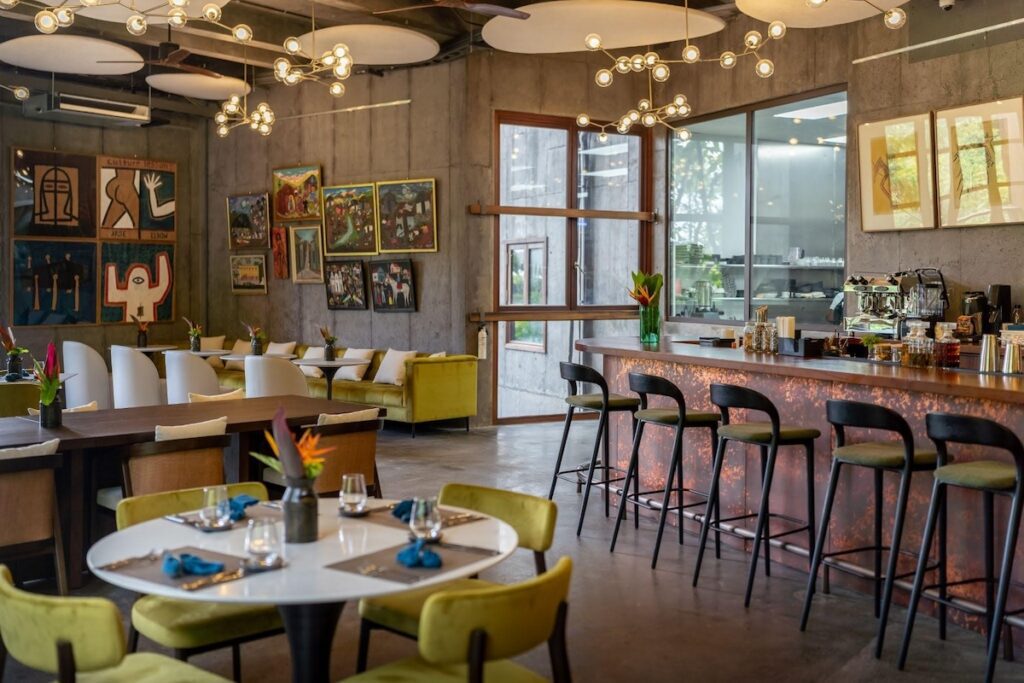
At the gallery opening, Sandra walked the room, moving from work to work. Michael Lees, the Dominican photographer who staged conceptual images of everyday life in the ruins left by Hurricane Maria. Marcel Pinas from Suriname, who uses letters and signs from the Surinamese Maroon alphabet. Luis Romero, the Venezuelan, has three drawings hung above. John Lie A Fo from French Guiana, with a naïve interpretation of Adam and Eve. Sheena Rose, the Barbadian, with a diptych of two friends gossiping on the phone in Bridgetown. Annalee Davis, also Barbadian, with schoolchildren’s reflections on the meaning of home, drawn on bagasse paper made from sugarcane debris. René Francisco, the Cuban critic of socialism and capitalism alike, with a banana tree protected by a human fence and the lyrics of a romantic calypso surrounding it. Carla Armour, the Dominican abstract painter, gifted the work that now covers the bottom half of the terrace bar.
Sandra closed her opening remarks with a question to the room. As you look at the work, she said, ask yourself whether it makes you uncomfortable, and why. Perhaps truth is also beautiful. Perhaps art and truth can set you free.
The next story in the series turns back to the property: a closer look at the 27 villas that exist today, and what 15 years of refinement have shaped them into.