Dominica, the Nature Island: Where Secret Bay Calls Home
The third in an editorial series of stories marking Secret Bay’s 15th anniversary. Previous stories covered how Secret Bay came to be and the luxury of time & space.
There’s a saying among Dominicans, often repeated by writers who pass through the Nature Island: if Christopher Columbus came back today, Dominica is the only place in his New World he would still recognize.
Five hundred years on, the mountains stand where they were. The rainforest is intact. The Kalinago, the last surviving indigenous people of the Caribbean, still live on their territory along the east coast. Of all the islands in the Caribbean, this is the one that stayed wild.
This is the country Secret Bay calls home, and the reason the resort exists at all. Founder Gregor Nassief was raised here, and his father was also born in Dominica, after his family arrived from Lebanon by way of Suriname and Martinique. He and co-founder Sandra Vivas built the latter half of their lives on the island together, after a 40-year absence and 15 years in Latin America. Gregor had long had a deep desire to return, to be closer to his family and to nature. This was the land that called them to build. Secret Bay sits on the cliffs and peninsula above Secret Beach, near Portsmouth on the northwest coast.
Dominica stayed wild because so few people live here. The island covers about 290 square miles, yet has a population of only around 72,000. It’s nearly twice the size of Barbados, with only a fifth of the number of inhabitants. Two-thirds of Dominica is rainforest simply because there was never pressure to clear it, and a significant amount of the land is protected and reserved.
Then there’s the water. Dominica has 365 rivers, one for every day of the year, running from the volcanic spine of the island down to both coasts. The Cario River runs straight through Secret Bay’s property. It’s one of the features visitors remember the most clearly.
The island holds nine potentially active volcanic centers, the highest concentration anywhere on Earth. The chain runs down the center of the country, creating Dominica’s famous geothermal terrain, including Boiling Lake, the second-largest hot spring in the world, which is reached on foot through the steaming Valley of Desolation.
For those who want to cross the whole island, the Waitukubuli National Trail runs 115 miles from Scotts Head in the south to Cabrits National Park in the north, divided into 14 segments. It was the first long-distance walking path created in the Caribbean and remains the longest, passing through Kalinago territory, the ruins of 18th-century French settlements, the rainforest, and the volcanic highland. Its name comes from the Kalinago word for the island, Waitukubuli, “tall is her body.”
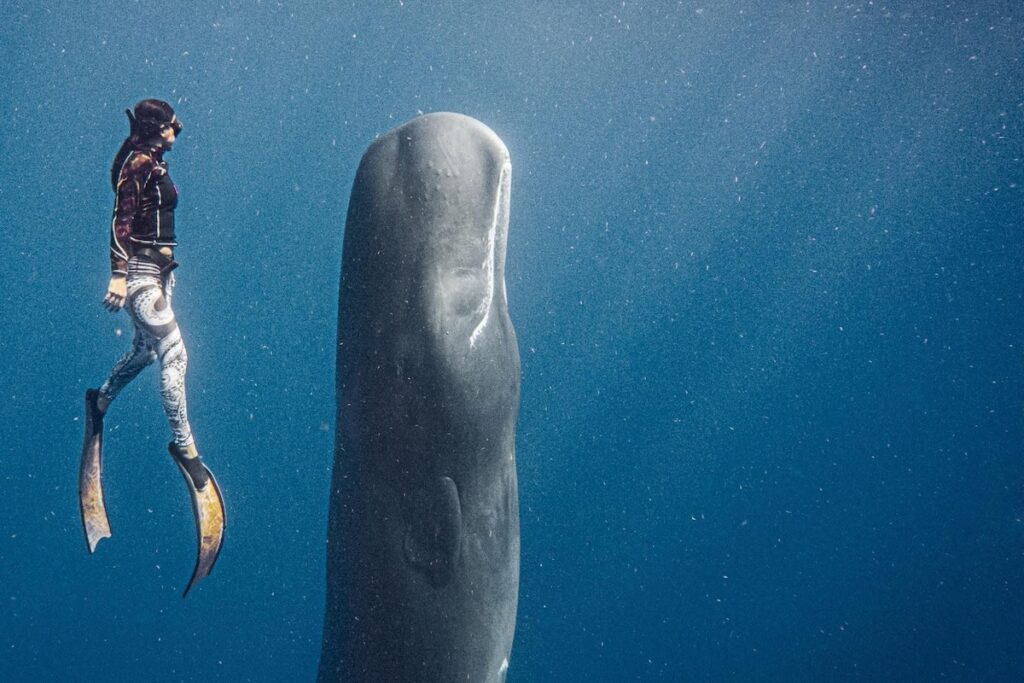
Offshore, the water is just as alive. Dominica is the only country on Earth where sperm whales can be seen year-round. Female and juvenile pods stay close to shore, and mature males return between November and March to mate. The deep ocean comes near enough to land that whales are sometimes visible from Secret Bay’s villas.
The country’s environmental record follows its geography. Dominica has set itself the goal of becoming the world’s first climate-resilient nation by 2030, and has been working towards it for years. A geothermal energy plant generates around 60% of the island’s energy, with hydro generating 25% and fossil fuel use down to just 15%. After Hurricane Maria tore through the island in 2017, the country adopted building standards designed to withstand the next storm. Secret Bay was rebuilt by hand.
What guests find beyond the property is what originally drew Gregor and Sandra here: the rainforest, the rivers, the trails, the whales, the Kalinago Territory, Trafalgar Falls, the Atlantic-coast villages where Creole French and Kalinago traditions still mix. The Indian River, near Portsmouth, where rowboats drift upstream beneath a canopy of bloodwood trees rooted in the water, a place Gregor knew as a boy. Champagne Beach, where geothermal vents send bubbles up through the seabed. None of it is packaged for tourism, and most of it can be reached and experienced with a Secret Bay guide whose family has lived on this coast for generations.
Secret Bay is a reflection of Dominica itself.
The next story in the series turns to Sandra and the collection that has grown alongside the resort. More than 200 works, three themes, and one of the most significant gatherings of contemporary Caribbean art on Caribbean soil.